
What Is FSCR?
FSCR stands for Fusion Setup and Configuration Skills Registry. It is an Oracle-published, GitHub-hosted collection of AI-oriented skills, scripts, and reference workflows designed to support planning, setup, and configuration of Oracle Fusion Cloud Applications.
Incase you were curious, it's pronounce like FiSCaR
Think of it like Oracle documentation that is supercharged, super focused, and structured in a way that is ideal for an AI Agent to read, instead of a human.
If you're expecting another application with menus, configuration screens, and a user interface, FSCR will seem wildly unfamiliar. It is not a conventional application that consultants install and launch. Instead, it is a repository of instructions and supporting resources that an AI coding agent uses to guide work. For all intents and purposes, FSCR is invisible and you will work with Claude Code, Codex or other AI coding agents as the front end.
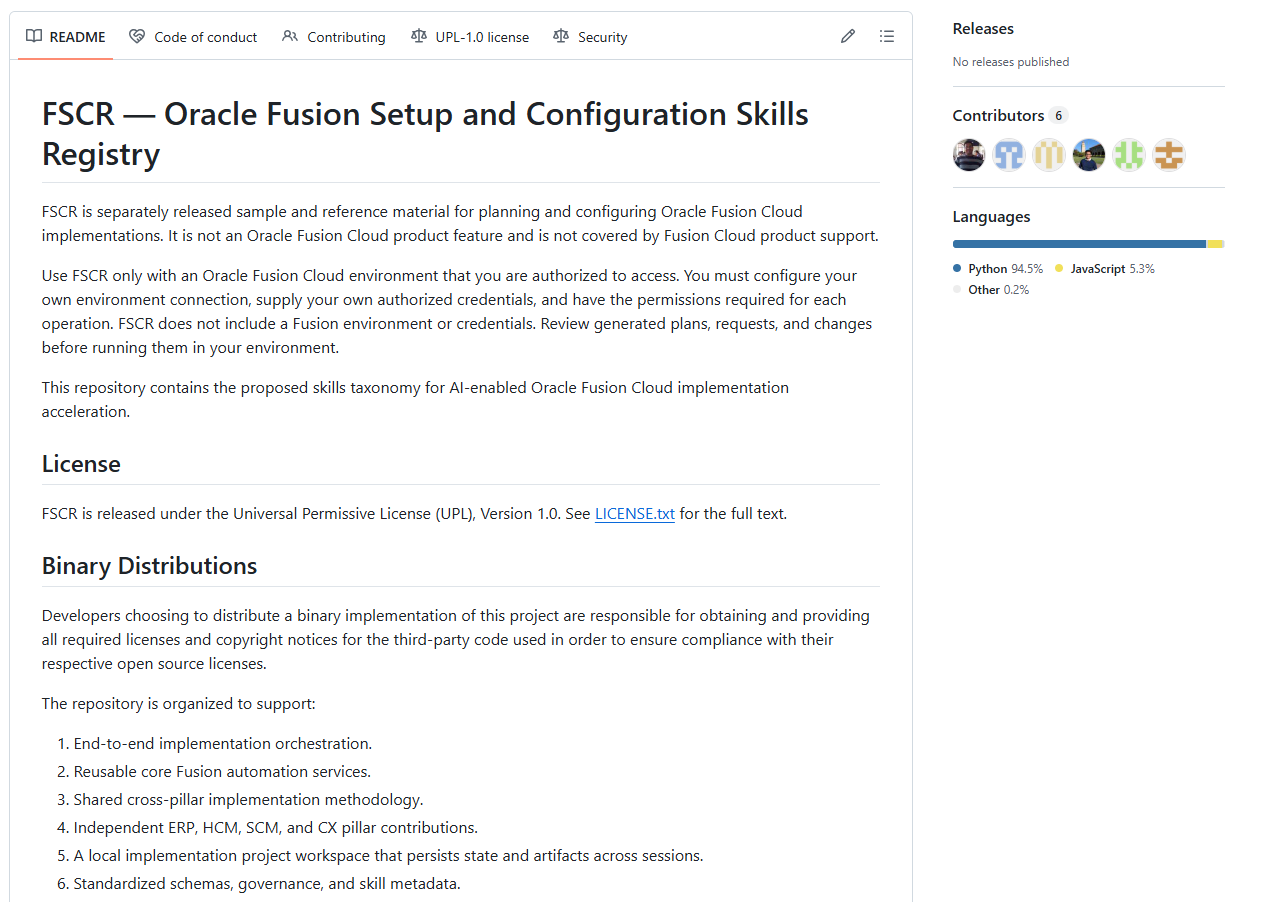
Oracle makes the source available on GitHub at Fusion Setup and Configuration Skills Registry, though your first step should be creating a fork or clone.
What is an AI coding agent?
An AI coding agent is an assistant capable of working with project files, instructions, scripts, and tools. Unlike a traditional chatbot that primarily responds with text, a coding agent can also navigate project resources and perform permitted actions like editing files and submitting REST calls. Practically speaking, this means things like Claude Code, Codex, and Antigravity.
FSCR fundamentally changes the way consultants operate
Oracle Fusion implementations are complex, and often lengthy. It's not just populating the fields and flags, but knowing how a decision will interact across other modules and business processes. These are things that traditionally, a certification can't always teach you, as you learn from years of industry experience along with implementation experience.
Experienced consultants know that a simple or minor configuration request can create problems elsewhere. A purchasing decision may affect receiving, inventory, accounting, reporting, and approvals. A change to an organizational structure may influence which locations users can access and how their transactions are processed.
Traditionally, teams manage these dependencies through implementation methodologies, spreadsheets, Smartsheet, Sharepoint, setup documents, reference guides, project meetings, Slack and Teams chats, and individual consultant expertise. We don't all know all the answers, but we know whom on our teams does!
FSCR makes it easy to standardize and organize that leading practice design information to work in concert with our teams. The AI Agent knows the structured implementation context, so consultants can focus on business processes and change management.
More than automating tasks, FSCR is a leading class tool to leverage leading practice design context about your industry.
Reduce repetitive research
Help consultants navigate reusable reference workflows rather than repeatedly locating and interpreting scattered setup material across Service Now, Sharepoint, Teams, One Drive, Box, or a thousand other similar systems.
Improve consistency
Provide common starting points for implementation activities that would otherwise depend heavily on individual experience. Finally, your experts can get a break from constantly answering the same questions for their team.
Capture dependencies
Bring attention to related configuration considerations before consultants finalize a design. There are so many things to consider, it's easy for humans to miss one.
Support continuous improvement
Make reusable implementation knowledge easier to refine as Fusion capabilities and leading practices evolve, but still through a controlled fashion where updates are approved before they are available.
How Does FSCR Work?
The best way to understand FSCR is The Matrix. Recall how Neo was strapped to a chair and the computer uploaded files to teach him how to fly a helicopter, or martial arts.
In this case, the AI Agent is Neo. FSCR is the set of files that provide structured guidance for selected Oracle implementation tasks. The consultant is Morpheus: Morpheus and Neo work together, complementing each other. Neither can succeed without the other, and in fact, it is Morpheus that takes Neo to The Oracle in the film. And, Morpheus controls what files are taught to Neo. Morpheus can edit the files and use his leading practice knowledge to help teach Neo faster.
Establish the implementation context
The consultant identifies the relevant Fusion environment, functional scope, and business objective and explains them in a conversational way to the agent. Authentication follows the repository’s documented flow using an authorized identity and the privileges assigned to it.
Engage the AI coding agent
The agent reads the available FSCR guidance - including your customizations- and identifies the appropriate implementation workflow.
Review requirements and dependencies
The consultant and agent work through questions, prerequisites, expected outcomes, and available configuration approaches.
Prepare and execute authorized work
Supported scripts or workflows assist with approved setup activities, subject to access controls and the capabilities of the environment. Available actions depend on the selected workflow, supported interfaces, and the authorized identity’s privileges.
Validate the results
Functional consultants review the outcome, test the business process, and document exceptions or follow-up actions. Retain the workflow’s runbook and configuration artifacts, where produced, as part of the implementation evidence.
The Systems Integrator Opportunity: Bringing Leading Practices to AI
The most compelling part of FSCR isn't what Oracle supplies out of the box. It's the fact that an experienced systems integrator contributes to it.
Systems integrators spend years developing implementation methodologies, process models, design principles, industry-specific recommendations, and lessons learned. But, that intellectual capital is distributed across presentations, spreadsheets, reference documents, internal knowledge repositories, and often still just exists in the minds of the consultant themselves.
These assets are valuable because they help teams answer a question that Oracle documentation has never resolved: not merely how to configure something, but how it should be configured for this client in this industry.
As long as Systems Integrators take the best of the best and apply it to skills inside of FSCR, then clients benefit from effectively having the best of the best team working on their project. They may not be there in terms of billable hours, but they will be in terms of their valuable skills and experience referenced by the team.
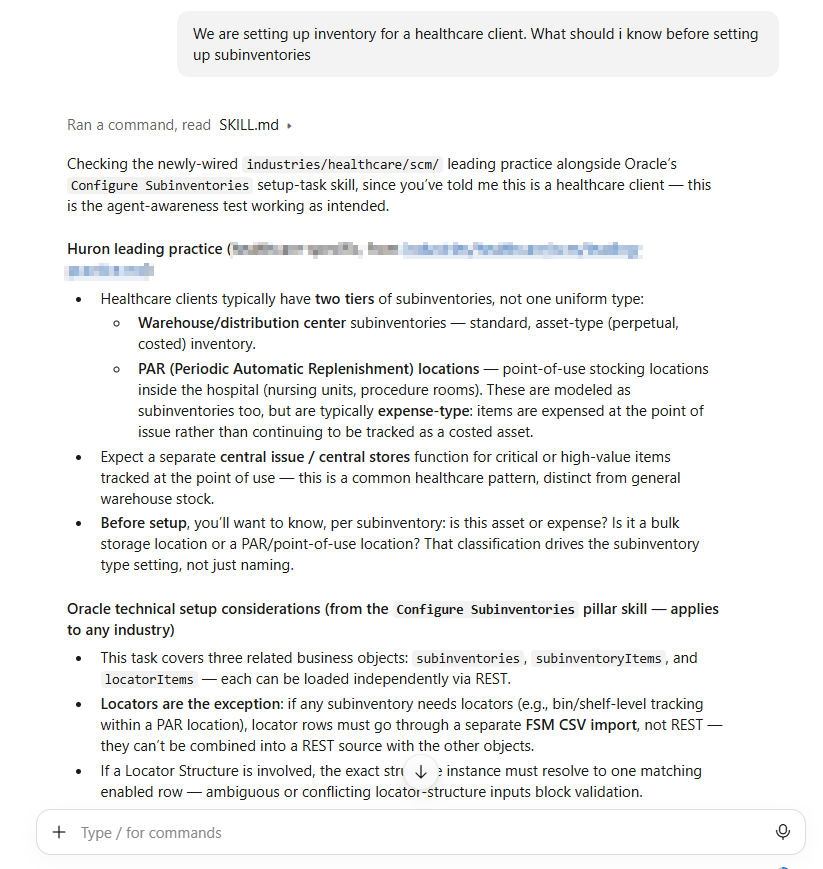
Consider a healthcare supply chain implementation
A hospital's supply chain design differs from that of a manufacturer or university. PAR replenishment, procedural supply management, distributor relationships, GPO pricing, clinical integrations, and bill-only purchasing create requirements that a generic configuration guide does not fully address, and those intricacies take years to learn.
A systems integrator with deep healthcare experience may already have developed recommendations for how those requirements should be assessed, what alternatives should be considered, and where common implementation problems emerge.
Imagine an agent that can help a consultant understand those industry considerations alongside Oracle's underlying configuration guidance.
The result will be a consistent starting point for design workshops, configuration planning, and testing. Less experienced team members would have better contextual guidance, while experienced consultants could focus more attention on decisions that require judgment.
AI Does Not Reduce the Need for Experienced Consultants
Each implementation involves business policies, legal entities, financial accounting, regulatory requirements, organizational responsibilities, existing integrations, security, and change management.
An AI agent helps explain a configuration dependency or handle the actual configuration step, but it cannot independently determine whether that action represents the right business decision.
| Activity | AI-assisted role | Consultant responsibility |
|---|---|---|
| Requirements | Organize questions and surface relevant considerations | Confirm actual business requirements and exceptions |
| Solution design | Provide reference patterns and possible alternatives | Evaluate tradeoffs and approve the design |
| Configuration | Handle the rote work of uploading configurations and smoke testing | Authorize changes and verify their correctness |
| Testing | Support test preparation, volume testing, and issue analysis | Build the critical path tests, validate real business outcomes and sign-off |
| Governance | Surface documentation and potential inconsistencies | Own security, change control, and accountability |
Practical safeguards
- Use approved AI agents only and follow organizational security policies.
- Keep credentials and sensitive client information out of shared code repositories. Understanding the risks of a public repo and best Git practices is key, and a new skill for consultants to learn.
- Use appropriate least-privilege access to Oracle environments.
- Review proposed configuration changes before execution.
- Separate experimentation from production operations.
- Document decisions, configuration outcomes, and validation results.
- Evaluate repository updates methodically, merge and handle conflicts, then update your own private repo. Again, new skills for consultants to learn.
Next Steps: Build Your Skills, Then Own Their Lifecycle
Start with one repeatable implementation question and an agreed business outcome. Treat the following as a recommended team operating model: a good skill needs an owner, a reviewer, a test, and a way to adopt upstream improvements without losing local expertise.
Who keeps the cutting edge sharp?
| Role | Accountability |
|---|---|
| Repository maintainer | Tracks Oracle upstream, prepares update branches, resolves conflicts, records baselines, and maintains rollback instructions. |
| Functional skill owner | Approves business recommendations, applicability, expected outputs, and changes to the organization’s own skills. |
| Technical / security reviewer | Reviews scripts, dependencies, authentication, data handling, and proposed execution permissions. |
| Test lead and business owner | Validate representative scenarios and accept business outcomes before project adoption. |
One person may hold several roles on a small team, but each change should have a named approver. Team review in your own repository is separate from contributing to Oracle’s repository: Oracle’s current contribution policy says external pull requests are not accepted. Use its documented issue and feedback channels for upstream suggestions.
This entire section is probably a brand new concept for most functional consultants. That's why I wrote it!
Could This Change the Oracle Implementation Model?
Obviously, FSCR deserves our attention, because it fundamentally changes what an SI provides, project timelines, as well as project quality. It also introduces new risks.
FSCR is a new delivery mechanism: structured, agent-consumable implementation knowledge that connects those resources into a conversational workflow.
For Oracle customers, the advantage is making implementation guidance easier to access and apply. For systems integrators, it creates an opportunity to turn more of their accumulated experience into reusable guidance that supports delivery teams consistently. For both, it can lead to higher quality implementations that have shorter timelines.
Coverage is workflow-specific. Check the current repository for support before promising optimization, migration, or a particular test scope. A smoke test does not replace cross-functional business acceptance testing. Broader coverage may emerge, but this article does not establish an Oracle delivery commitment or timeline.
AI scales the application of leading practices. It does not replace the expertise required to develop them.
I do not think the future of Oracle consulting will be defined by which organization can automate configuration the fastest.
It will be defined by which organizations can combine deep business expertise, current Oracle product knowledge, repeatable delivery methods, and responsible AI capabilities to produce better outcomes for their customers.